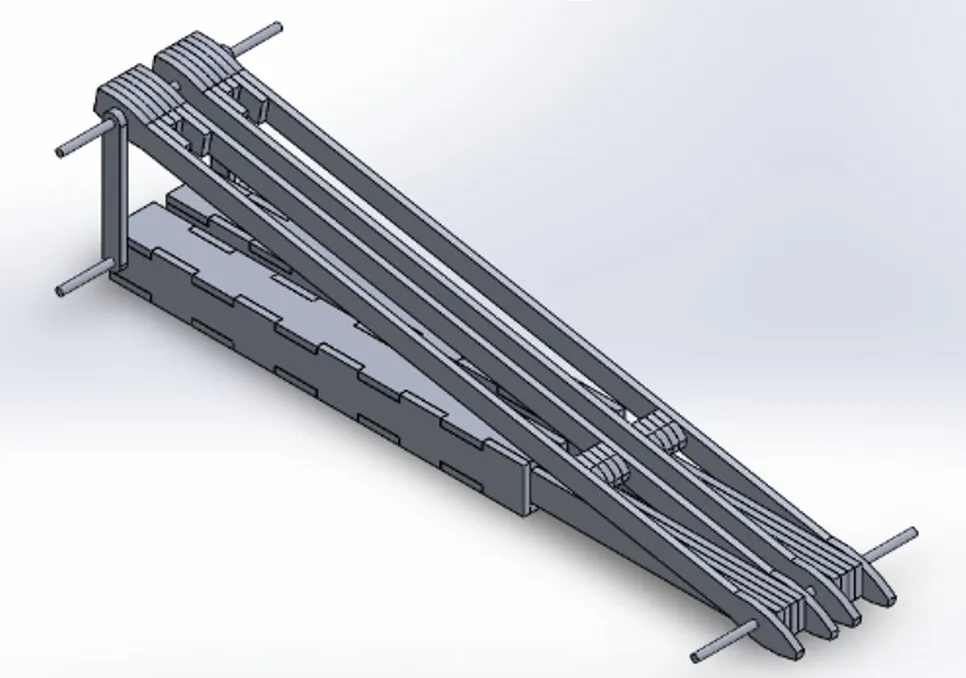
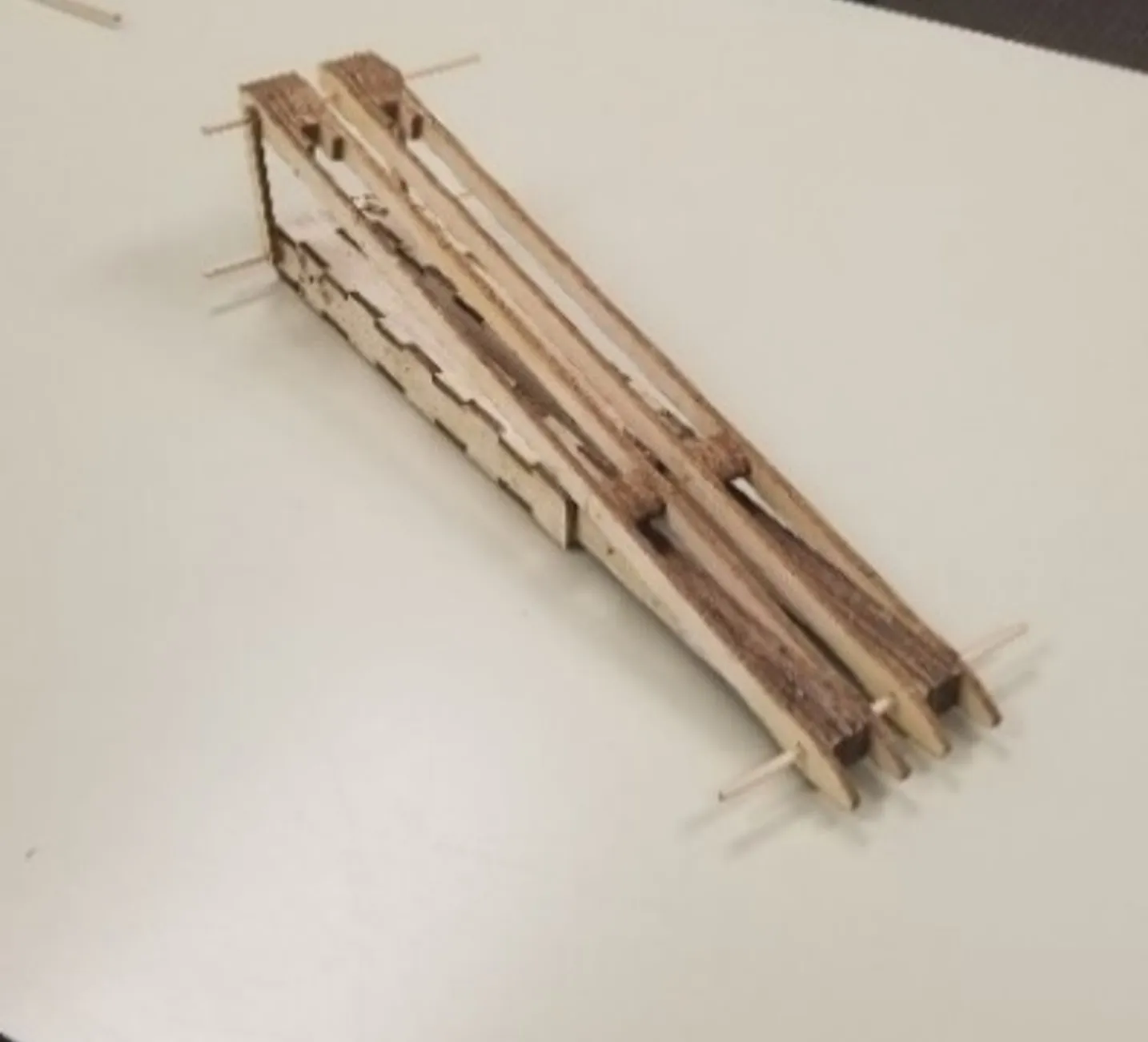
Balsa Wood Truss
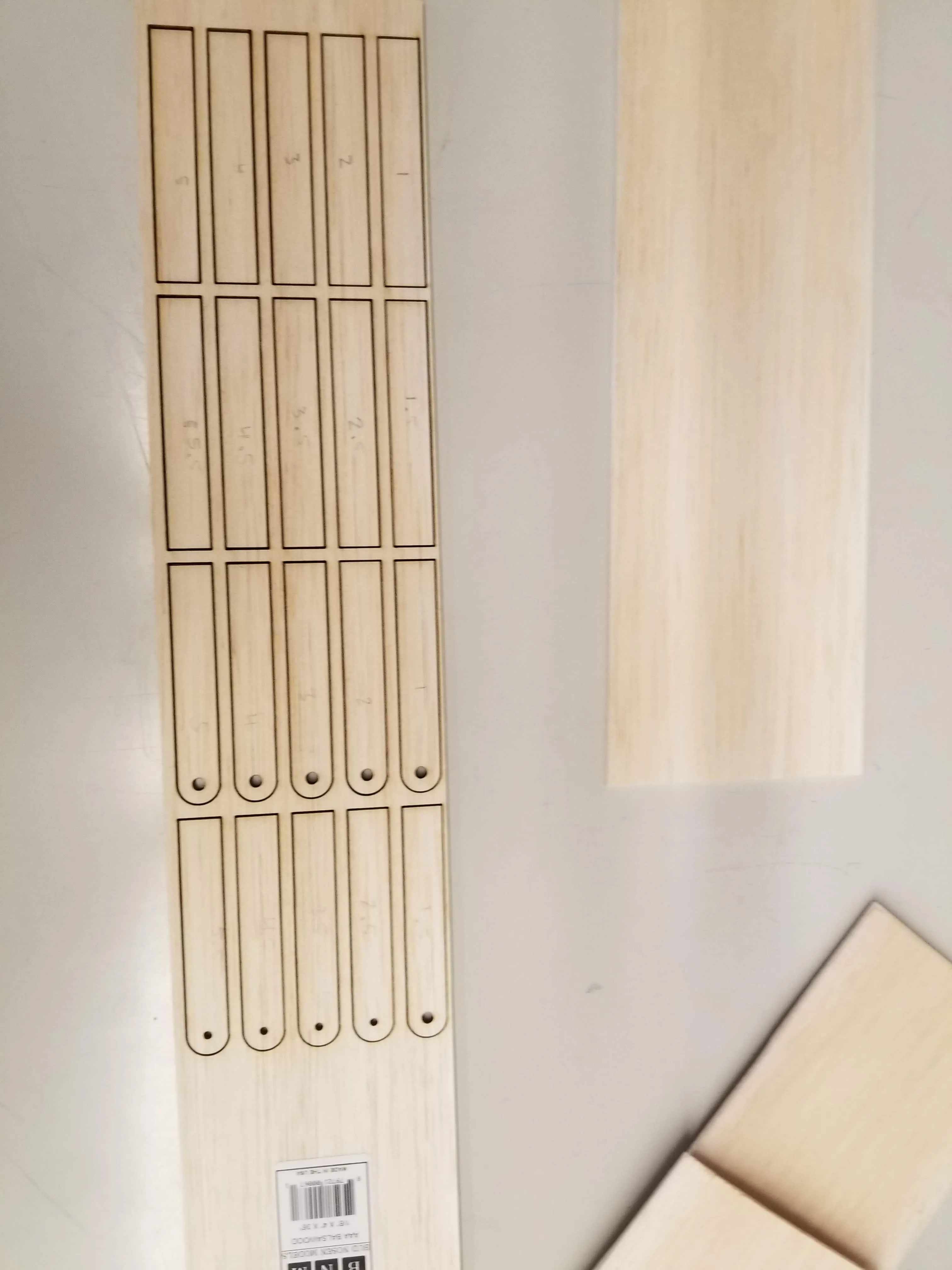
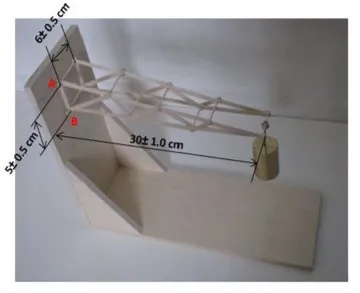
The goal was to design and build a cantilever truss out of laser-cut balsa wood that maximized its Performance Value (PV) — the ratio of maximum load held to the weight of the truss itself. The minimum required PV was 75, and each load had to hold for at least 5 seconds to count. Each team was given a set amount of building and prototyping material that we could not exceeded (this was confirmed on demo day by verifying the laser cut out trimming of each team)
Details
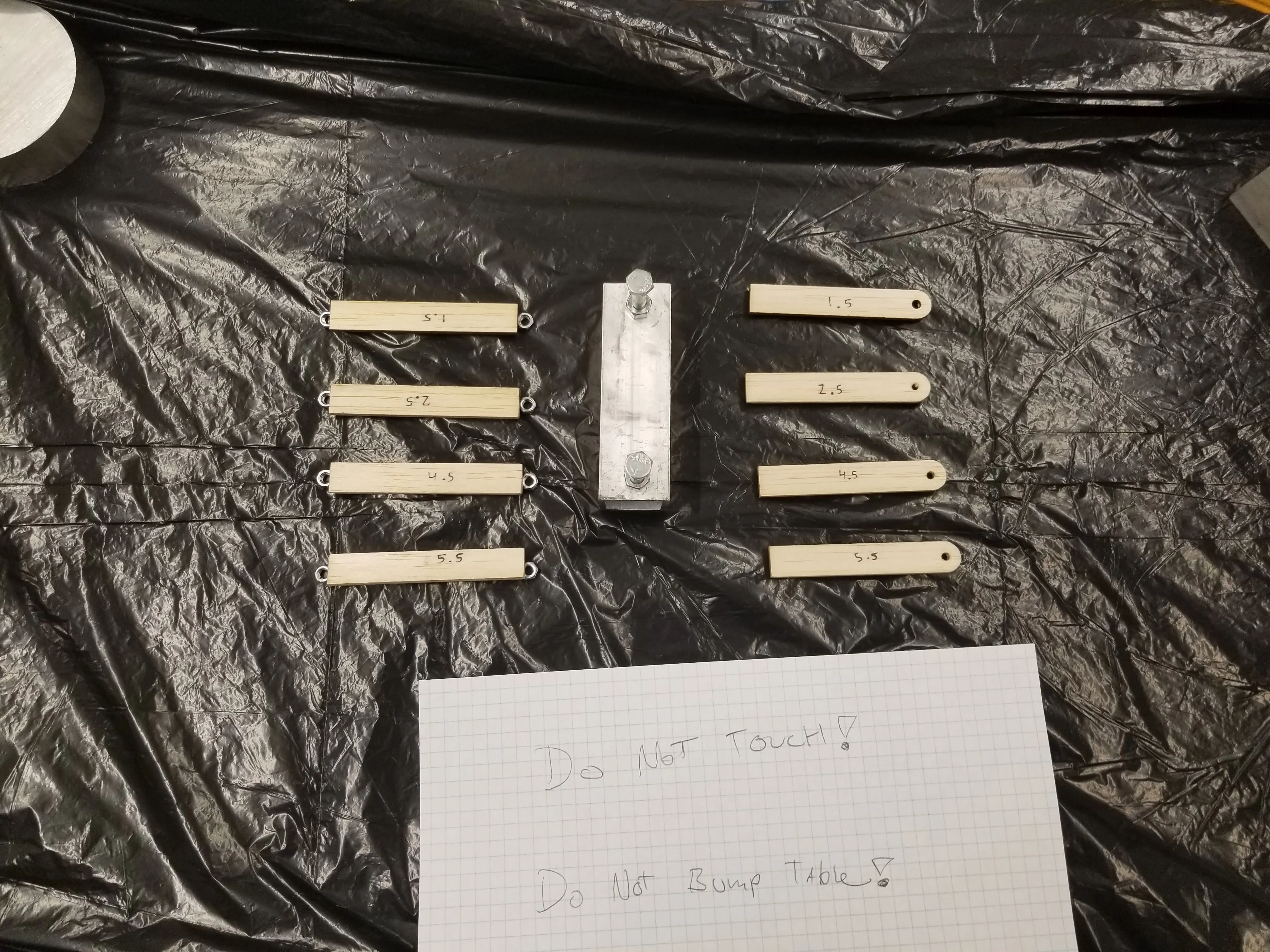
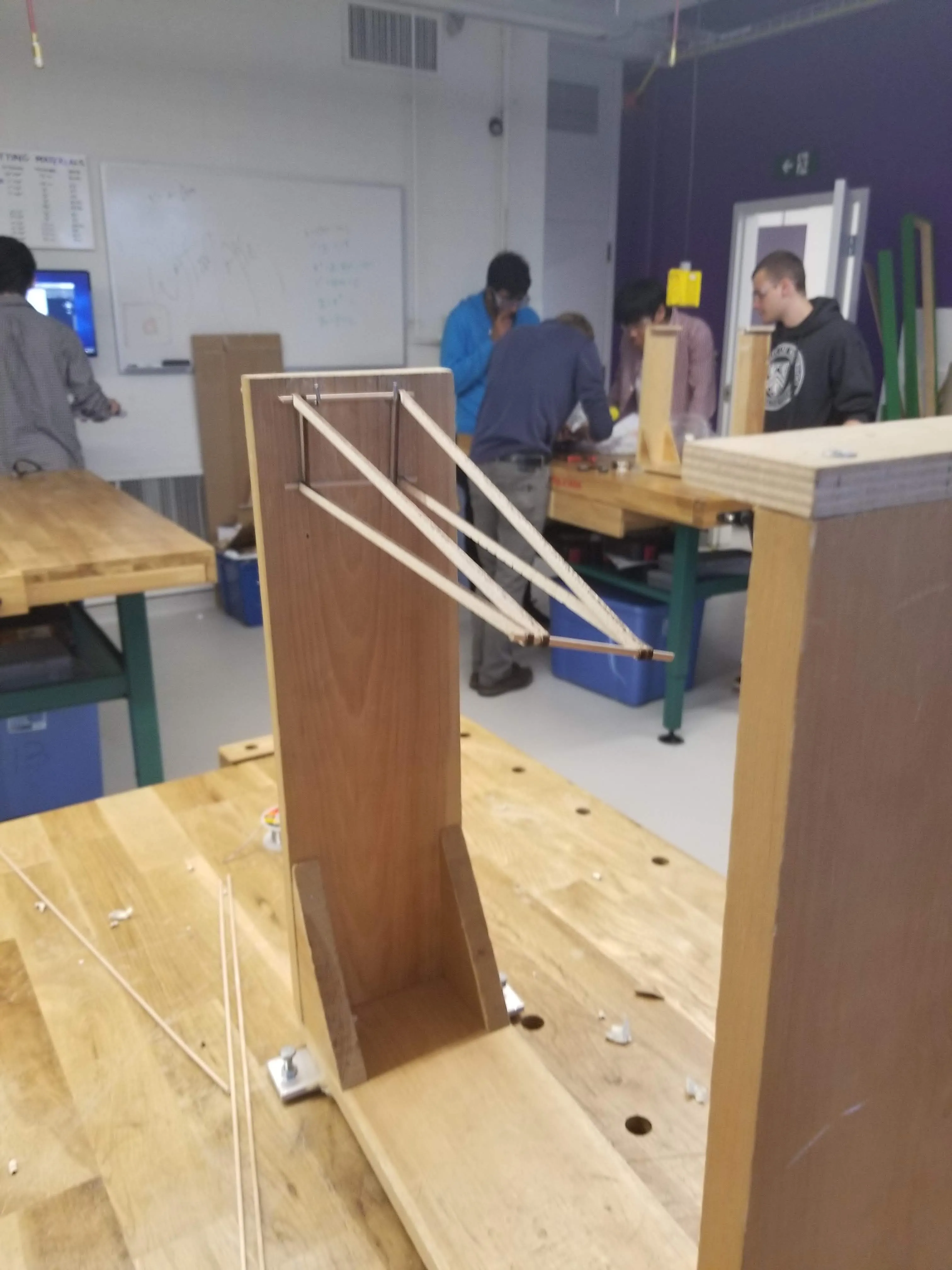
The core design philosophy was to “optimize towards infinity”, making members as large as possible rather than small, since balsa wood’s natural grain cracks become less significant in larger members and manufacturing imperfections have less proportional impact. The final design was a simple triangle: two solid box beams handling compression, and stacked tensile members with widened “bulbs” around the pin holes to resist tear-out failure. Hardwood dowels served as pins, and pin shear strength was the primary limiting factor for the maximum load.
Side note, I did make some concepts for compound pins by gluing multiple dowels together, but there was too much non-dowel space filled by the glue, and the dowel pins would only be bonded to neighbors by a narrow tangential line, so this idea was abandoned.
Early prototypes were too wide for the 6cm testing rig, requiring the box beams to be repositioned inline with the tensile members. As part of the project we had to do a “preliminary” Initial test till failure, to conserve our limited material, we chose to do an MVP test with the least possible material, which produced a PV of only ~40, with the tensile members shearing prematurely at the joints due to suspected construction damage to the balsa. Reinforcement was added to address this.
Because balsa wood is an anisotropic material due to it’s porous nature, grain, and small “cracks” and imperfections in the microstructure. I believed that due to the Griffith crack model , that the tensile stress would in balsa would fail before the compressive members. As an attempt to correct these material “imperfections” I made my own tensile and 3pt bending test rigs to test various surface treatments for balsa. I tried wood glue, cyanoacrylate, and clear coat nail polish on some test coupons, and plotted normal distributions for each one. The balsa wood used for this experiment was given to me by the course TA, as a sort of deal for having tried something new. Unfortunately, there were either no improvements in PV or the improvements were too negligible.
The final truss achieved a theoretical strength-to-mass ratio of 502.69. The team noted the box beams were over-engineered and heavier than necessary, and with more time would have hollowed them out to improve the PV further. And would have made the member cross-sections parabolically increase, as stress propagates parabolically through materials, removing unnecessary martials near the pins.
Although I don’t remember the PV of the final design tested on demo day, it was at least 125, as we achieved the highest performance bracket for grading.